If you have not had your eyes checked recently, you may wonder what to expect at an eye exam. Will your pupils be dilated? Which tests will you need? How long will everything take?
A comprehensive eye exam in Edmonton evaluates more than how clearly you can read an eye chart. It provides a detailed look at your vision, eye health, symptoms, and changing visual needs.
Your Exam Starts With a Conversation
Before testing begins, your optometrist will review your health and vision history. Be prepared to discuss:
- Changes in your vision or eye comfort
- Current glasses or contact lenses
- Medications and health conditions
- Previous eye injuries or procedures
- Family history of eye disease
- Screen use, work demands, driving, and hobbies
These details help your optometrist tailor the examination instead of giving every patient the same set of tests.
For your first visit, bring your current eyewear, medication list, insurance information, and any questions you want to discuss.
Checking How Clearly and Comfortably You See
Vision testing usually begins by measuring how clearly you see at different distances. Refraction testing then determines whether you need a new prescription for glasses or contact lenses.
Your optometrist may also assess how your pupils respond to light, how your eyes move and work together, and how well you see in your peripheral vision. These tests can uncover concerns that a standard eye chart may miss.
Children receive age-appropriate testing based on their development and ability to respond. Parents can learn more about pediatric eye exams.
Looking Beyond Your Glasses or Contact Lens Prescription
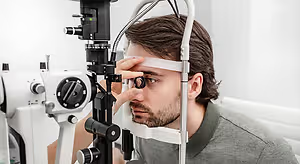
The eye health screening portion of the visit examines the structures at the front and back of each eye. Your optometrist may check eye pressure and use magnification to evaluate the cornea, lens, retina, and optic nerve.
A dilated eye exam may be recommended when a wider view of the retina is needed. Dilating drops temporarily enlarge the pupils and can cause short-term light sensitivity or blurred near vision.
EverSquare Eye Clinic also uses OCT retinal imaging and other diagnostic technology. OCT creates detailed cross-sectional images of the retina and optic nerve, while retinal photography records a broader image of the back of the eye. These technologies can help identify and monitor subtle structural changes associated with conditions such as glaucoma, diabetic retinopathy, and macular degeneration.
Patients with an existing condition or increased risk may benefit from ongoing eye disease management.
What Happens After Vision Testing?
Your optometrist will explain the results in clear language and answer your questions. Depending on the findings, the next step may be an updated prescription, monitoring, treatment, or a referral for additional care.
You will also receive guidance about when to return. The schedule depends on your age, symptoms, health, family history, and risk factors.
Comprehensive Eye Exam FAQs
What’s included in a comprehensive eye exam?
A typical exam includes a health-history review, visual acuity and prescription testing, eye coordination checks, eye-pressure measurement, and an evaluation of the internal and external eye structures. Additional imaging or dilation may be recommended.
How often should I get an eye exam?
For healthy, low-risk patients, Canadian guidance recommends annual exams for school-aged children and adults 65 or older, and exams every two years for adults ages 20 to 64. Your optometrist may recommend more frequent visits based on your individual needs.
What technology do you use to check my eye health?
OCT and retinal imaging provide detailed views of the retina and optic nerve. These images help your optometrist detect, document, and monitor changes that may not affect your vision immediately.
Is an eye exam different from a school or workplace vision screening?
Yes. A screening typically checks whether you can see clearly at a distance. A comprehensive exam also evaluates your prescription, eye coordination, focusing, eye pressure, and internal eye health. Passing a screening does not rule out an eye or vision problem.
What should I bring to my first appointment?
Bring your insurance information, current glasses or contact lenses, medication list, relevant medical information, and previous prescriptions if available. Sunglasses may also be helpful if your pupils are dilated.
Schedule Your Next Eye Exam
Understanding your vision begins with a thorough assessment. Request an appointment with EverSquare Eye Clinic to arrange your comprehensive eye exam in Edmonton.