When a child’s nearsightedness becomes stronger year after year, ordinary vision correction may not be the only option. Certain contact lenses can provide clear sight while helping slow myopia progression.
The first step is a personalized myopia management assessment. Your optometrist can review how quickly your child’s eyes are changing and determine whether myopia control contact lenses in Edmonton may be appropriate.
What Makes a Child a Possible Candidate?
Age alone does not determine whether a child can wear contact lenses. Your optometrist will consider several factors, including:
- The child’s current prescription
- How quickly the myopia is progressing
- Eye health and corneal shape
- Tear-film quality and lens comfort
- Daily activities and sports
- Willingness to follow cleaning and handling instructions
- Parent or caregiver support
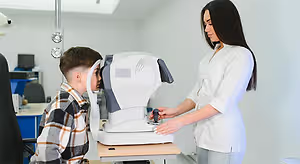
A pediatric eye exam establishes the baseline needed to recommend an appropriate plan. Children with changing prescriptions, a family history of significant myopia, or an early diagnosis may particularly benefit from a myopia-management discussion.
Soft Contacts, MiYOSMART, or Orthokeratology?
Soft contact lenses for myopia control use specially designed focusing zones. These lenses correct distance vision while changing how light reaches the peripheral retina, which can help reduce the signal that encourages the eye to grow longer.
MiYOSMART lenses use a related optical principle in a spectacle lens. Glasses may be a practical option for children who are not ready to handle contacts or who prefer not to touch their eyes.
Orthokeratology is another type of contact-lens approach. It uses custom rigid lenses worn overnight to temporarily reshape the cornea. The lenses are removed in the morning, allowing the child to see clearly during the day without glasses or daytime contacts.
These approaches are not interchangeable, and one is not automatically best for every child. Lens availability, prescription limits, comfort, lifestyle, cost, and the child’s ability to follow the treatment plan all matter. Parents searching for “myopia control near me” should look for an individualized recommendation rather than choosing a lens based only on convenience.
Is Your Child Ready for Contact Lenses?
Children do not need to reach one universal minimum age before trying contacts. Readiness is usually shown through behaviour.
A child may be ready if they can wash and dry their hands without reminders, avoid sharing or rinsing lenses with water, follow a wear schedule, and tell an adult when a lens feels uncomfortable. Parents should still supervise the routine until proper habits become consistent.
Children who frequently lose belongings, resist hygiene rules, or cannot follow instructions may be better suited to myopia-control glasses for now. Readiness can be reassessed later.
What Happens During the Fitting?
A contact lens exam and fitting begins with measurements of the eyes and an assessment of the prescription, cornea, and tear film. When appropriate, trial lenses may be evaluated for vision, movement, coverage, and comfort.
Your child will be taught how to insert, remove, and care for the lenses safely. Follow-up appointments allow the optometrist to check eye health, lens fit, wear habits, prescription changes, and myopia progression. These visits are an essential part of treatment.
Myopia Control Contact Lens FAQs
Can children wear contact lenses instead of MiYOSMART lenses?
In some cases, yes. Contacts may suit children who are motivated, active, and able to handle lenses safely. MiYOSMART may be preferable when a child wants glasses or is not ready for contact-lens responsibility.
At what age can a child start wearing contact lenses?
There is no single age that applies to every child. Eye health, prescription, maturity, hygiene, motivation, and the approved parameters of the recommended lens are more important than age alone.
Are myopia control contact lenses as effective as MiYOSMART?
Both specially designed contact lenses and myopia-control glasses have research supporting their use. Results vary by the exact product, wear time, age, prescription, and individual response, so effectiveness cannot be compared with one universal number.
How do I know if my child is ready?
Look for consistent handwashing, careful handling of personal items, the ability to follow routines, and honest communication about discomfort. Your optometrist can also assess readiness during the fitting.
What does a myopia control contact lens fitting involve?
The process includes a comprehensive examination, eye measurements, lens selection, an evaluation of vision and comfort, handling instruction, and scheduled follow-ups to monitor fit, eye health, and progression.
Find the Right Myopia Control Option
The best treatment is one that suits your child’s eyes and can be followed consistently. Request an appointment with EverSquare Eye Clinic to discuss myopia management for kids in Edmonton.